Watching the Inside: CIP-015 INSM with Zeek and Suricata
Internal Network Security Monitoring under CIP-015 — a passive sensor watching a SPAN of east-west OT traffic, catching the rogue DNP3 breaker command that the perimeter from post 4 can't see, decoded by Zeek and alerted by Suricata.
Post 4 put a wall around the grid equipment and one guarded door
in it, and then had to admit the uncomfortable part: the wall does nothing about the attack from
post 3. That rogue breaker command travelled from 10.10.20.12 to
10.10.20.11, both inside the perimeter, over a network segment the firewall never touches.
A firewall inspects what crosses a boundary. But the control-room software and the substation equipment inside the protected zone talk to each other all day, and that conversation never crosses the boundary, so the firewall never sees any of it. And that internal space is exactly where an attacker already is by the time they do anything: inside the ESP, speaking the normal protocol, and looking just like an operator.
If you can’t keep the attacker out, and you can’t tell their command from a real one, you’re left with one option: watch the inside of the network and notice when something happens that shouldn’t. In the regulations that’s CIP-015 — Internal Network Security Monitoring (INSM), the big new 2026 control, and this post builds it: a passive sensor, a mirror of the east-west traffic, and two tools that catch the exact command post 4 couldn’t see.
Where this fits. Post 5 of the series, and the one the whole thing has been building toward. Post 4 drew the perimeter; this post watches the space the perimeter can’t.
What is CIP-015?
CIP-015 (Internal Network Security Monitoring) requires that high- and medium-impact BES Cyber Systems monitor network traffic inside the Electronic Security Perimeter — east-west, not just at the boundary. It exists because the perimeter model has a blind spot the size of the entire internal network, and the regulators finally wrote a standard for it.
Three capabilities are required, and they map cleanly onto tools:
- Collect — get visibility into internal traffic. That’s a network mirror (SPAN/TAP) feeding a passive sensor.
- Detect — identify anomalous or unauthorized activity. That’s Zeek turning traffic into protocol-aware logs, and Suricata matching signatures.
- Evaluate and retain — keep the data long enough to investigate. That’s log retention, and in a fuller build a SIEM.
The key word is passive. An INSM sensor never sits in the traffic path; it can’t, or it becomes a point of failure in the middle of a control system. It just gets a copy of the traffic and is otherwise invisible: no IP address on the monitored segment, no packets sent, nothing for an attacker to hit.
The design
The sensor is mgmt-sensor, a VM in the management zone, outside the ESP, which is where an
INSM sensor belongs (it’s an EACMS, so it monitors the BES Cyber System without being part of it).
It has two network interfaces doing very different jobs:
- A management interface on the management zone (
10.10.10.20) — how I administer it. - A monitoring interface on the OT bridge with no IP address at all — a passive port that only ever receives a mirror of the OT traffic.
flowchart TB
    subgraph esp["ESP — 10.10.20.0/24 (firewall is blind to traffic in here)"]
        grid["ot-grid .10"]
        plc["ot-plc .11<br/>DNP3 outstation"]
        scada["ot-scada .12<br/>SCADA master"]
        scada -.->|"DNP3 CROB — east-west"| plc
        grid -.->|"Modbus poll"| plc
    end

    esp ==>|"SPAN: mirrored copy<br/>(tc, one-way)"| mon

    subgraph mgmt["Management zone — outside the ESP"]
        mon["mgmt-sensor monitoring NIC<br/>(no IP, promiscuous)"]
        zeek["Zeek<br/>(protocol decode → dnp3.log)"]
        suri["Suricata<br/>(signature → alert)"]
        mon --> zeek
        mon --> suri
    end
The double arrow is the key part: a one-way copy of the internal traffic leaves the ESP and arrives at a sensor that can never send anything back into it.
Setting it up
1. The mirror (SPAN)
The OT hosts sit on a Linux bridge (virbr-ot). To copy their traffic to the sensor without
sitting in the path, I use tc to mirror each OT host’s tap interface to the sensor’s monitoring
tap. Only VM-originated frames are mirrored, so the full conversation is captured once with no
duplication:
1
2
3
4
# for each OT tap, mirror VM-originated frames to the sensor's monitoring port
tc qdisc add dev "$src" ingress
tc filter add dev "$src" parent ffff: matchall \
    action mirred egress mirror dev "$sensor_tap"
The sensor’s monitoring interface comes up with no address and in promiscuous mode:
1
ip link set enp8s0 up promisc on   # no 'ip addr' — it never has one
The proof it works is a tcpdump on that passive interface, showing OT traffic the sensor is not a
party to:
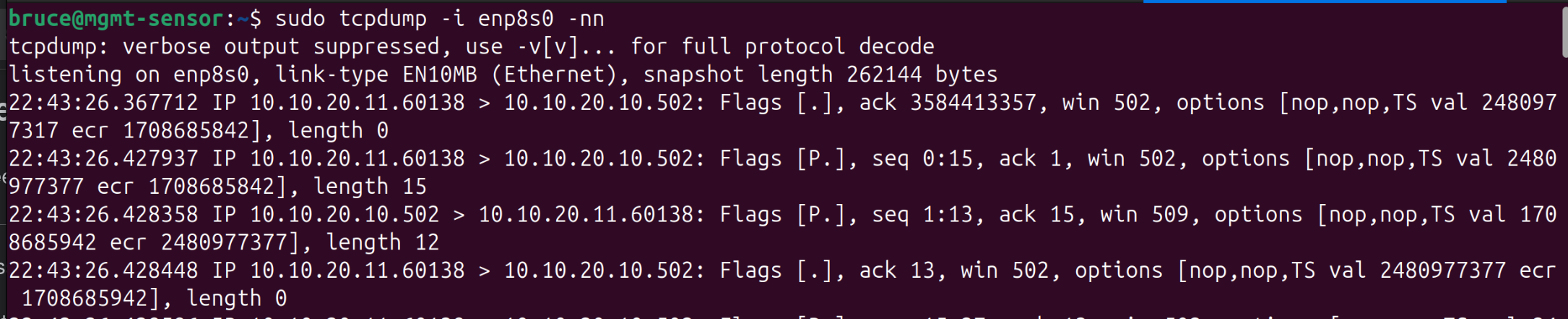 The sensor has no IP on this segment, yet sees
 10.10.20.11 ↔ 10.10.20.10 Modbus polling and the
DNP3 conversation. This is exactly the traffic the EAP in post 4 could not filter — because it
never reaches the EAP.
2. Zeek — turn traffic into protocol-aware logs
Zeek watches the monitoring interface and writes structured logs. The one that matters is
conn.log, whose service field names the application protocol it identified:
1
2
3
$ grep -E ':20000' conn.log | awk '{print $3, $4"->"$5":"$6, $8}'
10.10.20.12 53375->10.10.20.11:20000 dnp3_tcp
10.10.20.12 49193->10.10.20.11:20000 dnp3_tcp
dnp3_tcp — Zeek recognised industrial control traffic east-west inside the ESP, with no help from
me beyond pointing it at the mirror. And because Zeek 8 ships a DNP3 analyzer, it decodes the
function codes into a dedicated dnp3.log:
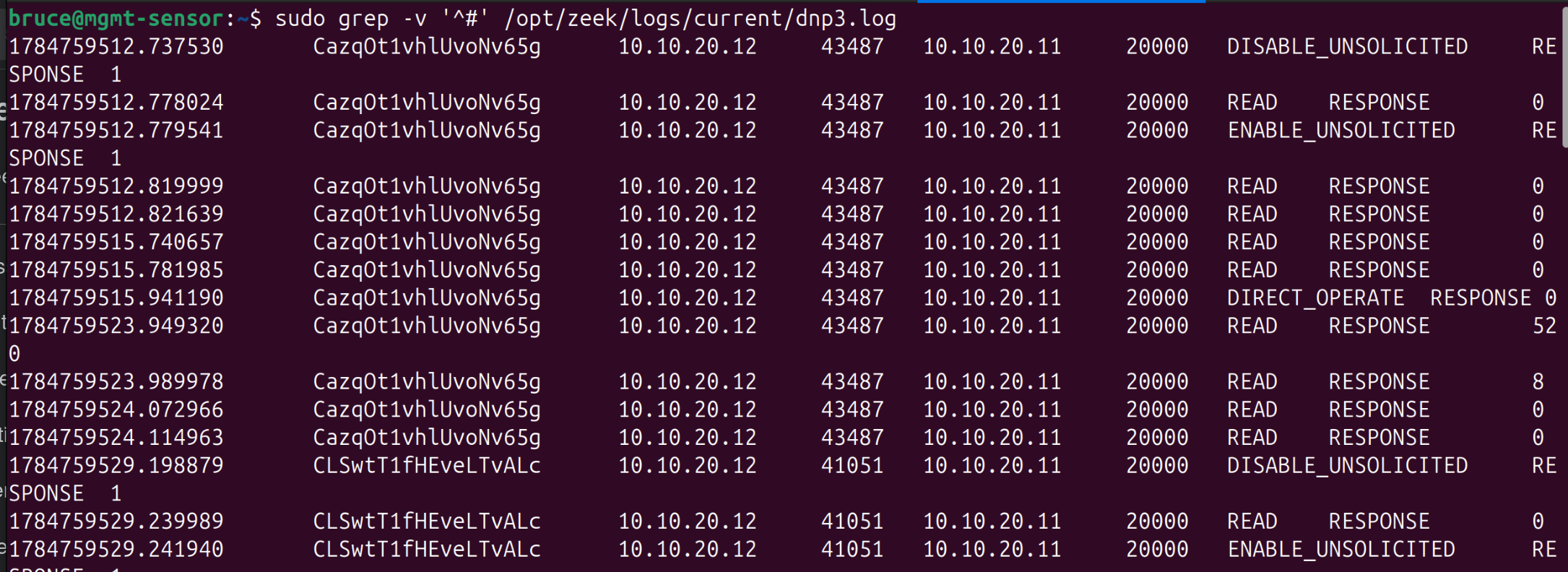 Zeek names the exact function. The polling reads are
 READ; the setup exchange is
DISABLE_UNSOLICITED / ENABLE_UNSOLICITED; and the breaker command is DIRECT_OPERATE — DNP3
function code 5, the CROB from post 3.
This is the whole point of the series landing. The command post 3 showed was byte-for-byte identical to a legitimate one, the one post 4’s firewall couldn’t see, is now sitting in a log labelled by function, on a sensor the attacker doesn’t even know is there.
3. Suricata — alert on the command that matters
Where Zeek just describes the traffic, Suricata makes a call on it. Here’s a signature that fires specifically on a DNP3 breaker operation:
1
alert dnp3 any any -> any 20000 (msg:"OT INSM CIP-015: DNP3 DIRECT_OPERATE breaker command (func 5)"; dnp3_func:5; sid:9000001; rev:1;)
Fire the rogue CROB from ot-scada, and the sensor catches it:
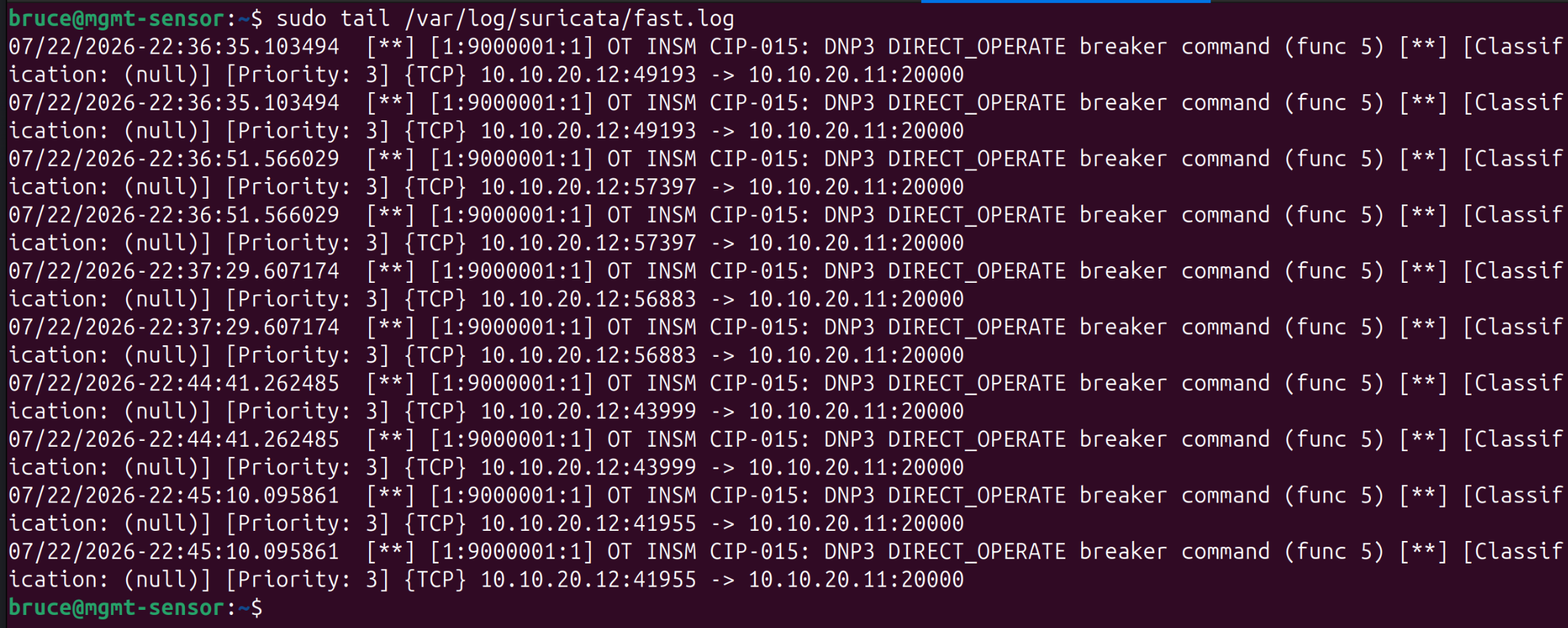
10.10.20.12 → 10.10.20.11:20000 — signature 9000001, DIRECT_OPERATE. The same command, now an
alert with a timestamp, a source, and a CIP-015 label.
1
2
$ jq -r 'select(.event_type=="alert") | "\(.timestamp[11:19])  \(.src_ip) -> \(.dest_ip):\(.dest_port)  [\(.alert.signature_id)] \(.alert.signature)"' eve.json
22:36:51  10.10.20.12 -> 10.10.20.11:20000  [9000001] OT INSM CIP-015: DNP3 DIRECT_OPERATE breaker command (func 5)
Two things that will waste your afternoon
Neither is in any tutorial, and I lost real time to both.
Zeek and Suricata both ignored the traffic at first, for different reasons.
Zeek saw the TCP connection but left service empty and produced no dnp3.log. The cause is
checksum offloading: virtual NICs hand checksum calculation to the hardware, so frames captured
off a virtual mirror carry checksums that look wrong, and Zeek silently drops them before any
analyzer runs. One line fixes it, and it is mandatory on any virtual SPAN:
1
redef ignore_checksums = T;
Suricata refused to even load the DNP3 rules — protocol "dnp3" cannot be used in a signature. The
reason is that Suricata ships with the DNP3 app-layer parser disabled by default:
1
2
3
4
app-layer:
  protocols:
    dnp3:
      enabled: no      # <- flip to yes
Both defaults make sense for a generic IT deployment and are exactly wrong for OT monitoring. If your sensor is quiet when it should be alarming, suspect the defaults before you suspect the mirror.
The CROB versus the SELECT: detection is a design choice
Real DNP3 controls often use select-before-operate: a SELECT (function 3) to arm the point,
then an OPERATE (function 4) to fire it. My lab uses DIRECT_OPERATE (function 5), which does
both in one message. A signature written only for function 5 would miss an attacker who used the
two-step form — so the ruleset covers 3, 4, and 5:
1
2
3
dnp3_func:5   # DIRECT_OPERATE
dnp3_func:4   # OPERATE
dnp3_func:3   # SELECT — stage one; catching this is catching the attack a step earlier
That last rule is the interesting one. A SELECT with no matching OPERATE from a source you don’t
expect is an attacker fumbling the sequence, which is about the earliest warning you can get. INSM
isn’t only about catching the command itself; it’s about knowing the protocol well enough to catch
the setup for it.
What INSM catches that the perimeter can’t
The point of building this next to post 4 is the contrast, so here it is directly:
| Event | Post 4 firewall (EAP) | Post 5 sensor (INSM) |
|---|---|---|
| Outsider connects to DNP3 port | Blocked and logged | (never reaches the sensor) |
| Jump host → OT over SSH | Allowed and logged | Seen as a session |
Rogue CROB, ot-scada → ot-plc |
Invisible — never crosses the EAP | Detected — Zeek decodes it, Suricata alerts |
Modbus polling ot-grid ↔ ot-plc |
Invisible | Baselined as normal |
The firewall and the sensor aren’t redundant. They each see a different half of the network, and only together do they cover all of it. That’s the whole reason CIP-015 was added on top of the perimeter standards instead of folded into them.
Verifying it worked
INSM is real if all four hold, and all four do:
- The sensor is passive —
ip addron the monitoring interface shows no address, and it never transmits. It cannot be a path into the ESP. - It sees east-west traffic —
tcpdumpon that interface shows the OT hosts talking to each other, traffic the EAP never receives. - Zeek decodes the protocol —
conn.logreportsdnp3_tcp, anddnp3.lognames the function codes. - Suricata alerts on the breaker command — a CROB produces signature 9000001 with source, destination, and timestamp.
The CIP-015 assessment
| Capability | Current state | Finding | Risk | Remediation |
|---|---|---|---|---|
| Collect (INSM-01) | Passive SPAN via tc to a no-IP sensor port |
Mirror is host-config, not persisted as a service | Reboot loses monitoring silently | Systemd unit that re-establishes the mirror on boot |
| Detect (INSM-02) | Zeek decode + Suricata signatures for DNP3 func 3/4/5 | Signature-only; no baseline/anomaly detection | Novel technique with no signature slips through | Add Zeek behavioural scripts; alert on new talker pairs |
| Evaluate & retain (INSM-03) | Logs on the sensor | No central collection or retention window | Evidence ages out; no correlation | Forward Zeek/Suricata to a SIEM (post 6 territory) |
The honest gap is INSM-03. Detection without retention and correlation catches the event but loses the investigation. A single sensor with local logs is fine for a demo, but a real program needs that data going somewhere it’s kept and searchable.
Pros and cons
| Pros | Cons |
|---|---|
| Catches the exact attack the perimeter cannot see | Signatures only catch what you thought to write a rule for |
| Sensor is passive — no new attack surface inside the ESP | A mirror on a busy segment is a lot of data to store and search |
| Zeek’s protocol decode turns raw traffic into readable evidence | Virtual SPAN gotchas (checksums, disabled parsers) are silent failures |
| Maps directly onto the three CIP-015 capabilities | One sensor, one segment — real networks need many |
Wrap-up
The blind spot is covered now. A command that crosses no boundary, carries no exploit, and looks identical to a legitimate one is now decoded, named, and alerted on, by a sensor the attacker can’t see and can’t reach. None of the tooling is exotic: a SPAN port, Zeek, and Suricata are the same stack IT defenders have run for twenty years, just pointed at OT traffic. What’s new is the regulator finally requiring it inside the perimeter, because that’s where the grid attacks actually happen.
Two posts left. The findings have been piling up: broad egress rules, an undocumented anti-lockout rule, SSH on the perimeter device, a mirror that isn’t a real service, logs that go nowhere. Post 6 stops writing those up as prose and turns them into code: CIP-010 configuration baselines and evidence collection you can actually run and diff, so “we’re compliant” becomes something you prove on demand instead of just asserting.
References
- CIP-015 — NERC Reliability Standards
- Zeek · DNP3 analyzer · Suricata · Suricata DNP3 keywords
- Network Security Monitoring with Security Onion on Proxmox — the same sensor stack, IT-facing
- Linux tc mirroring